

Pricing is a topic that’s hard to talk about and even harder to do well. For a private training program in boutique fitness, pricing is a combination of math, market research, and intuition. Get it right and the program could be profitable from the start and the best business decision you’ve ever made. Get it wrong (in either direction) and you’re either leaving money on the table or spending months wondering why sessions aren’t selling.
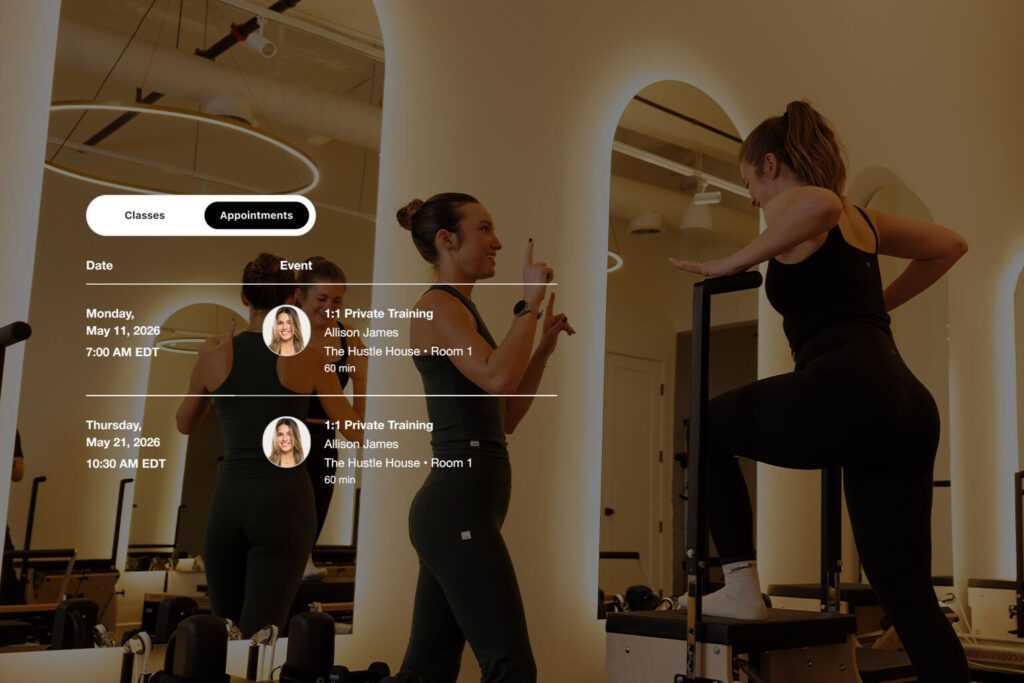
To better understand pricing and packing for private training, we spoke with two Mariana Tek team members who also own studios and have done this exercise themselves:
- Jackie Futrell, Enterprise Account Executive at Mariana Tek and owner of Training Mate in East Dallas
- Cody Stitely, Mariana Tek Onboarding Lead and owner of Motive Fit.
Here’s the advice Jackie and Cody gave us.
1) Don’t anchor on your group class rates
The most common pricing mistake in private training is treating it as a logical extension of class pricing. If a drop-in class is X, then a private session should be 3 times that number, right?
Not necessarily. According to Jackie, there isn’t a direct correlation between class and private pricing. “Private training pricing is really driven by the instructor’s experience level and the environment you’re providing,” Jackie says.
That means a studio offering private sessions in existing group fitness space with the same group fitness equipment might not be able to charge as much as a studio with a fully built-out private room and specialty equipment. A Pilates instructor with fifteen years experience and high-level certifications will command more than someone with a foundational certification. Price to reflect what you’re actually delivering, and don’t forget to factor in benchmarks for your geographic area.
2) Understand the margin math first
The gap between what you charge and what you pay your trainer is just your gross margin. Franchise royalties, transaction fees, platform costs, and admin time all come out of that spread, too.
“If my instructors get paid $75 for teaching a group class, and I’m considering paying them $50 for a private session while charging the client $75 — on that $75 I pay the trainer $50, I pay a royalty to the brand, and there are transaction fees. I might walk away with $10.”
Jackie Futrell, Enterprise Account Executive at Mariana Tek, owner of Training Mate in East Dallas
You can’t price based on what feels reasonable or competitive without knowing what you actually take home at that price.
Read more: Is Private Training Right for Your Studio?
3) Expect to iterate
It’s improbable that you’ll get pricing exactly right from the start. Cody has seen this firsthand with his studio’s version of private sessions: recovery services.
Cody initially priced Motive Fit’s recovery offerings higher than the market would bear, saw slower-than-expected adoption, and adjusted. “Overpricing in the beginning is a classic mistake,” he says. The lesson isn’t to undercharge, but to expect iteration. Your launch price isn’t permanent!
Watch the signals: If you’re getting interest but not conversions, the price might be too high. If you’re selling out immediately, you may have left margin on the table.
| Tek Tip: Price recovery services and niche offerings differently. If your program includes recovery services like sauna, cold plunge, compression, or red light therapy, give them their own pricing logic. Recovery tends to attract a broader audience than traditional private training, including people who wouldn’t typically walk into your studio. This opens up pricing structures that wouldn’t apply to one-on-one coaching: standalone session pricing for non-members, day passes, retail-style packages, etc. The key question for any niche offering is what your local market will bear. Cody’s advice: Watch what competitors in your area are charging, pilot a price point, and be willing to adjust. |
4) Choose the right packaging structure
How you package private training matters as much as the price itself. Some options to consider:
- Single sessions – Lowest barrier to entry and easiest to sell to first-time buyers, but they create no forward commitment and leave revenue unpredictable. They are better for an introductory format than an ongoing business model.
- Session packs (bundles) – The most common structure because they generate upfront revenue, lock in client commitment, and improve retention. The key question is how much to discount without eroding margin.
- Membership add-ons – A potential option for studios with a strong membership base. Cody built recovery sessions into Motive Fit’s unlimited membership as a monthly perk: Members get one free session, with the option to purchase additional sessions at a package rate.
5) Be strategic about intro pricing
It’s a challenge to convince people to try something new, especially when it’s a big investment and might be outside their comfort zone. Introductory pricing can bridge that gap, but it works best when tied to a specific offer versus a simple discount.
A few ideas from Cody:
- First session pricing – A reduced rate for a single introductory session, framed explicitly as a one-time offer. The goal is to get them started, not establish a lower ongoing price.
- Rewards and milestones – Cody uses Mariana Tek’s rewards system to give members a free recovery session at class attendance milestones. Once people try it and enjoy it, they’re likely to buy more.
- Events and community moments – Motive Fit offered free cold plunges at their one-year celebration. Make the first experience feel like a community event rather than a sales pitch!
TL;DR: Introductory pricing is for conversion, not revenue. Price the intro offer to remove friction, then have a clear path to a paid package.
Pricing benchmarks by modality
Not sure where to start? The table below shows estimated market ranges across modalities and studio types. Keep in mind that these are approximate figures and vary by geography, instructor level, and the environment you’re offering.
| Modality | Format | Estimated price range |
|---|---|---|
| Pilates | Group class (e.g. Club Pilates, BODYBAR) | $25–$49/class or $109–$229/month membership |
| Pilates | Private 1-on-1 reformer (independent studio) | $75–$150/session |
| HIIT / Group training | Group class (e.g. Orangetheory, F45, Barry’s) | $32–$38/class or $59–$300+/month membership |
| Personal training | Commercial gym (Planet Fitness, LA Fitness, Crunch) | $40–$70/session (in packages) |
| Personal training | Boutique studio or independent trainer | $75–$150+/session |
| Personal training | Ultra-premium (e.g. Equinox) | $150+/session |
| Recovery services | Independent boutique studio | Varies widely by service and market |
Note: Metropolitan markets (NYC, San Francisco, etc.) typically run 20–30% higher than suburban markets across all categories.
What’s next?
Your pricing is in place, the team is staffed, and the systems are built. The last piece is getting clients in the door and keeping them coming back. In the final article of this series, we’ll cover how to launch and grow your private training program.
Catch up on the rest of the series below:

by Maddy Crouch Sr Product Marketing Manager, Fitness & Wellbeing
Contributor: Maddy Crouch Sr Product Marketing Manager, Fitness & Wellbeing
-
First published: August 03 2026
Written by: Maddy Crouch