

After running the numbers and looking honestly at your market, you’ve decided private training is a fit. Now you have to build the infrastructure to actually run it.
As you know, running a group fitness schedule is an operational beast of its own, as owners and operators have to manage capacity, instructor schedules, waitlists, and retention across a high volume of clients.
Private training adds another layer of complexity on top of that. Every session is its own transaction: Individually scheduled, individually priced, tied to a specific trainer, and attached to a client relationship that has to be actively managed.
The systems that make group fitness run smoothly—both on a booking platform and in the studio—don’t automatically extend to appointment-based programs.
Here’s what to think through before taking your first private booking.
1) Make the mindset shift from classes to appointments
It’s important to wrap your head around the differences between these two before building something new. Private training is more personal and more premium than a group class, and paying clients expect it to feel that way at every touchpoint.
In a group class, one instructor delivers the same experience to anywhere from 5 to 30+ people. The session is designed for the average participant. Private training flips that: The session is built around one person (or a small group of 2–3), their goals, their limitations, and where they left off last time. It’s a fundamentally different service, and the systems supporting it have to reflect that.
“The higher the price point, the higher the expectation.”
– Cody Stitely, Mariana Tek Onboarding Lead, owner of Motive Fit in Pennsylvania
Everything needs to match the premium experience clients are paying for: How they book, how they’re communicated with, how sessions are documented, and the client journey between bookings.
2) Get your booking infrastructure right
Booking is where a lot of studios stumble first, especially when they try to layer private training onto a class-based schedule without the right tools.
Before Mariana Tek launched Appointments, Cody ran Motive Fit’s recovery services using workarounds, like texting to book. It worked, but it suppressed demand: the studio looked like it had less availability than it actually did, and clients who didn’t see their preferred time simply didn’t buy.
Once Motive Fit started using Appointments, clients could see full availability and self-book directly, which led to a 30% increase in bookings.
A good booking system for private training needs:
- Visible availability – Clients need to see what’s open and book without having to ask. If they have to text first, you might lose out.
- Separation from your class schedule – Don’t let private training clutter your group schedule. Clients should be able to toggle between the two cleanly.
- Client self-service – Make it easy for clients to manage their own appointments, including rescheduling and cancellations. The more friction you remove, the more people book.
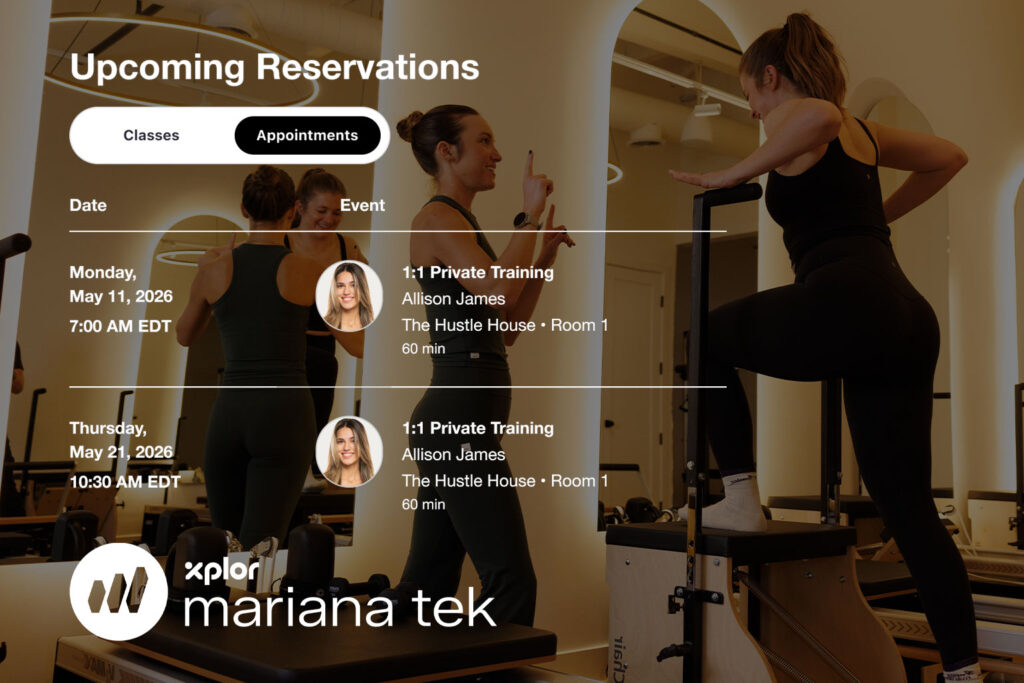
There’s another less obvious reason to get this right: When booking flows through a central platform, the client relationship belongs to the studio. When it happens through a trainer’s personal phone, the client belongs to the trainer (and could leave with them, should the staff member ever quit).
3) Build your intake process
In most cases, there isn’t much intake needed for a group class. With private training, the instructor needs more information: Fitness history, any injuries or medical considerations, and what the client hopes to achieve. There’s often a baseline assessment as well, whether that’s a movement screening in the first session or a standalone consultation before physical work begins. The right structure varies by modality, but without this foundation, the trainer will be operating on guesswork.
Cody also pointed out the importance of ongoing notes. “If you’re seeing five clients every day, you’re not going to remember where someone left off.” A system where trainers log what was covered each session—and can refer to that before the next one—is what separates a personalized experience from a generic one.
4) Design the client experience intentionally
This includes both the space itself and style of the experience. In the first blog of this series, we covered the space choice: 1) Using idle time in your existing space, or 2) building out a dedicated private training space.
Read more: How To Identify If Private Training Is A Fit For Your Studio
Whichever model you’ve chosen, you’ll also need to consider:
- Equipment fit – Does the space have what private sessions actually need?
- Privacy and atmosphere – Some clients want the energy of the main floor; others want something quieter and more contained.
- Capacity – Can your space support two trainers holding sessions simultaneously? If so, that changes the volume math considerably.
According to Jackie Futrell, an Enterprise Account Executive at Mariana Tek who spent years at boutique fitness brands including Barry’s and BODYBAR and now owns Training Mate in East Dallas, designing the private training experience also differs from group class. For example, what should a first session look and feel like? What about ongoing sessions? How does the client know they’re making progress?
The specifics also vary by modality. Jackie points out that in Pilates, clients often use private training to advance their practice and make things harder. That emotional context is different, and the experience should reflect it.
TL;DR: Private training should feel premium and personalized from the first touchpoint, not like it’s just a group class with only one client.
5) Know what you’re building before opening the doors
Our biggest piece of advice: Don’t launch before the infrastructure is ready!
A big sign of trouble is if the trainer and client both show up, but nobody has decided how intake works, where notes live, or what success looks like. Jackie notes that having the foundational systems in place is what determines if the sessions are worth the price you’re charging—and if clients will come back.
Operational checklist before your first booking:
- Booking platform configured with visible availability, separate from your class schedule
- Intake form built and trainer-facing documentation ready
- Space confirmed and equipped for one-on-one sessions
- Client experience defined (first session and ongoing)
- Trainer notes process in place
What’s next?
Your program’s operational foundation is in place. Now, who’s going to deliver these sessions? In the next article, we’ll cover how to staff a private training program, including how the skill set differs from group instruction, how to structure compensation, and how to make sure the client relationship stays with your studio.
Turn private sessions into your next revenue engine.

by Maddy Crouch Sr Product Marketing Manager, Fitness & Wellbeing
-
First published: July 08 2026
Written by: Maddy Crouch