

Boutique fitness is thriving in Boston, with studios outperforming national benchmarks by nearly every financial measure. But the same qualities that make it a premium market also make it fiercely competitive and challenging to win loyalty in.
We analyzed all active studios in the Boston metro area on the Mariana Tek platform for our recent Boston Regional Data Report. Here’s the data behind the “premium” designation, and advice for studios operating in (or considering entering) the Boston market.

Data debrief: Boutique fitness in Boston
The data in our report paints a picture of a premium, high-performing market:
- Average monthly revenue per studio: $40.3K (+25% vs. US)
- Average class cost: $24 (+9% vs. US)
- 7.7 classes before converting to membership (+43% vs US)
Higher revenue per location is driven primarily by pricing power at the class level. Membership pricing is only marginally higher than the US average, so the real edge comes from what Boston consumers are willing to pay per visit.
Not all modalities are alike as far as pricing power. HIIT classes cost $24 on average, more than 27% higher than the US overall, and Pilates/Lagree/Megaformer classes come in at $26. On the other side, Spin classes are the most accessible price point in the market at $16.
Memberships for HIIT and Pilates are both well above the national baseline at $296 and $276 respectively.
Boston is a Pilates-led market
It’s a Pilates world, and we’re all just living in it—especially in Boston! Pilates (including Lagree and Megaformer) is the most popular boutique workout in Boston, with 43% of studios offering this modality.
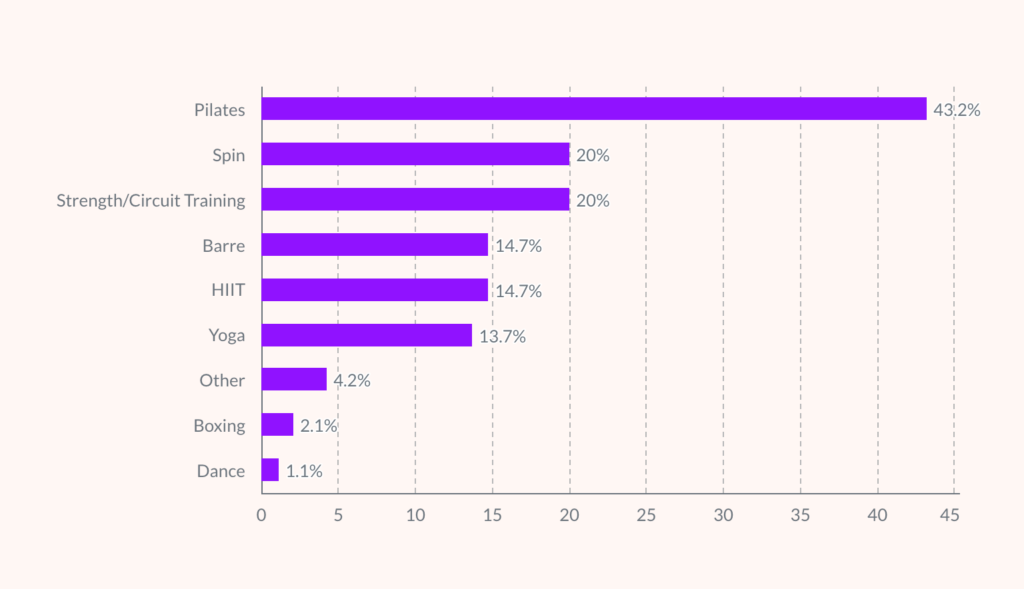
Pilates tends to be one of the most expensive modalities. In Boston, unlimited Pilates memberships cost $276 on average—37% higher than the average across all modalities. The popularity of this workout paired with the higher cost shows just how much Boston customers are willing to pay.
However, it’s not “Pilates or bust.” Even with the dominance of these formats, diversification is taking hold in Boston: 26% of studios now offer more than one modality. As the market matures, studios that can offer variety without diluting their brand experience will position themselves well among the competition.
Boston clients take longer to commit
A more premium market means more competition and more options for customers to choose from. Boston clients are shopping around, attending an average of 7.7 classes before converting to a membership, a full 2 classes more than the US average of 5.4. Of all the cities and regions Mariana Tek has analyzed, Boston has the longest conversion runway.
Retention data paints a similar picture. Attrition is front-loaded and steep:
- 42% of first-time clients never return after their first visit
- 69% churn before their 5th class
- The steepest single drop in the entire customer journey occurs between visits 1 and 2
The selectivity of Boston clients means studios have to work harder and longer to earn a commitment. The window to make an impression is narrow.

Advice for Boston studio operators
Price with confidence. Boston consumers are paying above-average prices across modalities, and studios are generating 25% more revenue per location. The cost of living in the city—50% above US average—means customers won’t be shocked by higher prices at their favorite studios. If you’ve been hesitant to raise prices, the market data supports it.
Design intro offers for a longer runway. In a city where conversion takes 7.7 visits on average, an intro offer that caps out at 1 or 2 classes is asking clients to commit well before they’re ready. A 2-week unlimited or multi-class pack gives new visitors time to make a decision, and gives your studio more touchpoints to make a strong case.
Act fast after the first visit. The steepest drop in retention for Boston studios happens between visits 1 and 2. Most clients who return for a second visit do so within 4 days of their first. A same-day follow-up or an automated nudge in that window can make all the difference.
The Boston opportunity
Boston isn’t an easy market. The clients are discerning, the competition is steep, and earning loyalty takes longer here than almost anywhere else in the country. But the studios that crack the conversion challenge benefit from consumers who spend more and show up consistently, leading to per-studio revenues high above the national average.
What opportunities will you spot in the data?
Trends in Boutique Fitness: Boston

by Julie Sippy Senior Marketing Manager
-
First published: July 06 2026
Written by: Julie Sippy