

There’s a moment a lot of studio owners have. The 9am class ends, the floor clears out, and for the next two hours the space sits mostly empty. Or a client asks if you offer one-on-one sessions, and you realize you’ve been sending that revenue somewhere else. Or you look at your schedule and think, “What if we’re leaving something on the table?”
Private training feels like a natural next step for a boutique fitness studio offering group classes. In many cases, it is. But the studios that make it work asked the hard questions before they launched, not after.
Every situation is different. Before you hire additional staff, build out a room, or start selling packages, ask yourself these questions to identify if private training is the right fit for your studio.
1. What are you actually building?
This sounds obvious, but it’s where a lot of studios go wrong. There are two different models, and each one requires different levels of investment, infrastructure, and commitment.
- Model 1: Using idle time in your existing space. You’re running private sessions on your current floor during off-peak hours — no buildout required. The lower upfront cost makes this the more accessible starting point, but it also means your private training schedule is constrained by your class schedule, and clients share the same environment as your group program.
- Model 2: Building out a dedicated private training space. You’re creating a separate room or area used exclusively for private sessions. This gives you more scheduling flexibility, a distinct client experience, and the ability to invest in equipment that serves private training specifically — but it adds a significant fixed cost in the form of additional square footage.
Jackie Futrell, an Enterprise Account Executive for Mariana Tek who spent years working at boutique fitness brands like Barry’s and BODYBAR and now owns Training Mate in East Dallas, says these “are almost two different businesses.” Either way, you’re building a real program with real operational requirements, so you need to get clear on which model you’re pursuing before you go any further.
2. Who will be your private training buyer?
The common assumption is that private training is a natural upsell to group fitness clients. Sometimes that’s true, but the person who loves a 6am HIIT class three times a week and the person who wants personalized, one-on-one coaching might not be the same person. Their motivations, price sensitivity, and even schedules might be completely different.
According to Jackie, private training tends to attract:
- People with more disposable income who are willing to pay a premium for personalized attention
- People focused on longevity who want something tailored to where they are physically vs. a class designed for the average participant
- Clients focused on specific outcomes: injury recovery, performance goals, a life event like a wedding or a race
- Clients who find group class intimidating and need an on-ramp before they’re ready to join
These are just a few examples. As Jackie notes, geography and demographics matter too: “Florida is a great example. There’s a ton of private training and Pilates there because of the older demographic who may not want a group class setting.”
Cody Stitely, an Onboarding Lead at Mariana Tek who runs Motive Fit in Irwin, Pennsylvania and offers recovery services as an appointments-based model alongside group classes, saw something similar: Their recovery room brought in people who had never set foot in a boutique fitness studio. For some of them, it became an entry point into everything else Motive Fit offers.
Questions to ask yourself:
- Does my current client base include people who fit the profile for private training?
- Are there enough of them?
- Is my market (neighborhood, city, demographic) one where this kind of offering has demand?
- Am I trying to convert existing clients, attract new ones, or both?
Private training can expand your addressable market, not just upsell your existing one. But only if you’re reaching the right people.
3) Do the numbers make sense?
The margin math on private training is tighter than it looks. Here are the variables you need to work through before making any commitments.
- Square footage cost (if adding dedicated space) – Rent is typically a studio’s largest fixed expense, and a dedicated private training room could be a meaningful increase. Before anything else, calculate what that additional square footage costs per month. That’s the absolute minimum you’d need to cover with new revenue.
- Opportunity cost (if using existing space) – Every private session is competing with what that slot could generate as a group class. A Pilates studio booked solid from 5am to 8pm needs to ask whether one private session at $150 is worth skipping a class with 20 people in it.
- Trainer compensation by modality – This is where the math diverges. In HIIT or strength training, you might pay a trainer $50 a session and charge $100. In Pilates, a qualified instructor with more certifications could expect closer to $100 a session, which compresses the margin considerably. Equipment costs narrow it further.
- The full cost stack – The headline math (session price minus trainer pay) rarely reflects reality. Franchise royalties, transaction fees, admin time, and front desk support all come out of that number. Jackie offered an example scenario where a session priced at $75 nets the owner around $10 after paying royalties, fees, and $50 to the trainer. At that margin, volume becomes everything.
- Hidden costs people regularly underestimate – Don’t forget to consider less obvious cost centers:
- Marketing – Private training often requires a completely separate funnel with different messaging, different channels, and potentially paid ads targeting a new audience.
- Operational build-out – Intake processes, session structure, and program design all have to be created from scratch. Most studio systems are built for classes.
- Admin and coordination – Managing trainer availability, scheduling changes, and client communication takes meaningfully more time than adding a class to a schedule.
4) How much are the intangibles worth?
The numbers above are the most important, but there are other legitimate reasons to offer private training that might not show up clearly in a margin calculation.
Staff retention. In boutique fitness, a lot of instructors piece together income from multiple studios. If you can offer private training hours on top of group classes, you might be able to give someone a full schedule at your studio alone, boosting retention and the sense of community.
Client lifetime value. A member who does both group classes and private training has a deeper relationship with your brand. They’re less likely to churn, more likely to refer friends, and more forgiving when things don’t go perfectly.
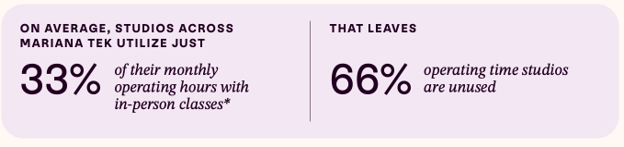
Off-peak monetization. Mariana Tek data shows that the average studio uses only about a third of their total monthly operating capacity, and the hours between 1pm and 4pm (“off-peak” hours) consistently underperform. Private training is one of the few ways to generate meaningful revenue from time slots that don’t justify a full class.
Jackie’s advice is to treat these areas as a bonus, not a full justification to start private training: “Make sure the numbers work on paper first.”
The Owner-as-Trainer Exception
The math is entirely different in one scenario: When the studio owner is the one delivering sessions.
Eliminating the payroll cost might take sessions from marginal on paper to genuinely profitable. Jackie notes that private training might be more of a passion project for owners who choose to offer these sessions. While much of their day to day may be dedicated to the business side of things, private training gives them a chance to spend time with clients and get back to coaching. And, it might work better financially because they are the ones on the floor.
If that’s you, some of the margin concerns above matter less. The risk is that this model doesn’t scale. It depends on your availability, and that can put a ceiling on growth.
A Framework for Making the Call
Model:
- Are you filling idle time or building a real program?
- Who is delivering sessions, the owner or other staff? Existing instructors or new hires?
Demand:
- Does your current client base show meaningful demand for private training?
- Is your market (neighborhood, demographics, price sensitivity) one that supports it?
- Are you converting existing clients, attracting new ones, or both?
Economics:
- What’s your cost structure: space, trainer comp, overhead?
- What’s the minimum session volume to break even at your target price point?
- What are you giving up if you allocate that space or those hours to privates instead of classes?
What’s next?
This is the first in a series of articles helping boutique fitness studio operators build a private training program from scratch. Next, we’ll cover:
- The operational foundation
- Staffing
- Pricing and packaging
- Launching and growing your program
Stay tuned for more!

by Maddy Crouch Sr Product Marketing Manager, Fitness & Wellbeing
-
First published: June 08 2026
Written by: Maddy Crouch